5 CV Mistakes Every Chef Makes (And How to Fix Them Fast)

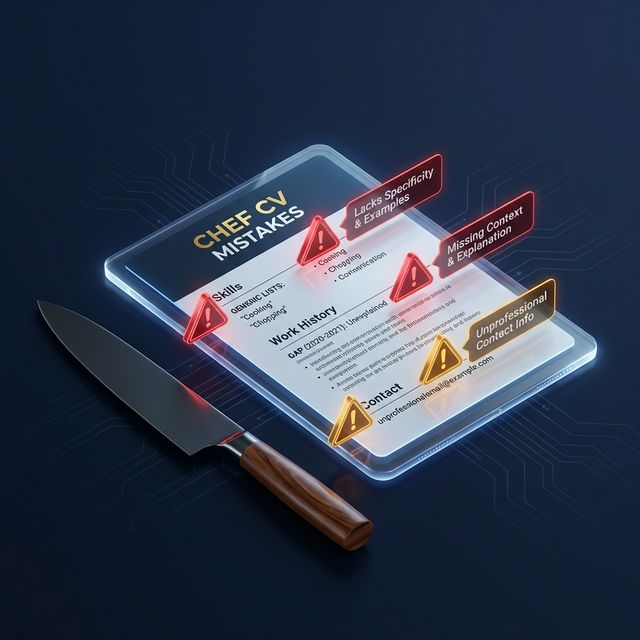
After reviewing hundreds of chef CVs across London, Manchester, Edinburgh and Birmingham over the past two decades, a frustratingly familiar pattern emerges. The same five mistakes appear again and again — from first-year commis chefs to seasoned executive chefs running multi-site operations. These are not minor formatting niggles. They are substantive errors that cause recruiters and hiring managers to pass on otherwise talented chefs.
If you are actively looking for a kitchen role in 2026, read this before sending your next application. Every one of these mistakes can be fixed in under 15 minutes.
Mistake 1: Listing Duties Instead of Achievements
This is, by far, the single most common mistake on chef CVs. The overwhelming majority read like a copy-and-paste job description rather than a record of what you actually accomplished.
Why it matters: A recruiter scanning 60 chef CVs in a morning already knows that chefs “prepare food” and “maintain hygiene standards.” They do not need you to tell them that. What they need to see is how well you did it, how efficiently, and what impact you had on the kitchen.
Bad example:
“Responsible for food preparation and cooking meals for guests. Maintained kitchen hygiene. Supervised junior staff.”
Good example:
“Prepared and plated 120+ covers per service across a 6-course tasting menu, maintaining a 4.8-star average review score on Google. Reduced food waste by 18% through improved prep scheduling and portion control.”
The difference is striking. The first tells the recruiter what you were supposed to do. The second tells them what you actually accomplished and how well you did it.
The Quick Fix
For every bullet point on your CV, ask yourself: “What was the result?” If your bullet point describes a task without an outcome, rewrite it. Include numbers wherever possible:
- Covers per service: “Delivered 80–150 covers per service in a high-volume brasserie kitchen”
- Food cost %: “Maintained food cost at 28% against a 32% budget target, saving the venue £14,000 annually”
- Team size: “Led a brigade of 12 across hot, cold and pastry sections”
- Review scores: “Kitchen achieved AA 3 Rosette standard within 6 months of appointment”
- Revenue impact: “Developed a seasonal tasting menu that generated £8,500 additional weekly revenue”
- Training: “Trained and mentored 4 commis chefs, 2 of whom were promoted to CDP within 12 months”
If you cannot remember exact numbers, use honest estimates. “Approximately 100 covers” is infinitely better than “cooked food for guests.”
Mistake 2: Burying (or Forgetting) Food Safety Certifications
In the UK, food safety is not optional — it is a legal requirement under the Food Safety Act 1990 and EU Regulation (EC) No 852/2004 (retained in UK law). Yet a surprising number of chef CVs either bury their certifications at the very bottom or forget to include them entirely.
Why it matters: UK law requires at least one person in every food business to hold a Level 2 Food Hygiene Certificate. Many employers expect Level 3 Food Safety for sous chef and head chef roles. HACCP training is increasingly expected across all levels. And since Natasha’s Law (2021), allergen awareness certification has moved from “nice to have” to “essential.”
A 2024 survey by the Chartered Institute of Environmental Health found that 73% of UK food businesses consider food safety certification a non-negotiable requirement when hiring kitchen staff, yet only 41% of chef CVs it reviewed listed their certifications prominently.
The Quick Fix
Create a dedicated “Certifications” section immediately after your skills or education. List every relevant certification with its date:
- Level 2 Food Hygiene Certificate (2024)
- Level 3 Food Safety in Catering (2023)
- HACCP — Hazard Analysis and Critical Control Points (2024)
- Allergen Awareness — Natasha’s Law Compliant (2024)
- First Aid at Work — 3-Day Certificate (2023)
- Fire Safety Awareness (2024)
If you do not have Level 2 Food Hygiene — get it. It is available online for under £25 and can be completed in a single day. It is the single cheapest investment you can make in your culinary career.
Mistake 3: Using a Generic Personal Statement
Read this and tell us if it sounds familiar:
“I am a hard-working and passionate chef looking for a new opportunity to develop my skills in a fast-paced kitchen environment.”
This could describe literally every chef on the planet. It tells the recruiter absolutely nothing specific about you, your experience, your cuisine specialisms, or what you bring to their particular kitchen. It is the CV equivalent of a blank plate.
Before & After: Personal Statement Rewrites
Bad — Commis Chef:
“Passionate commis chef looking for work in a busy kitchen.”
Good — Commis Chef:
“Enthusiastic commis chef with 18 months of experience in a 2 AA Rosette kitchen in central London. Trained in classical French technique with a focus on sauce work and fish preparation. Food Hygiene Level 2 certified. Seeking a CDP role where I can continue developing my skills in fine dining.”
Bad — Sous Chef:
“Experienced sous chef seeking a new challenge.”
Good — Sous Chef:
“Senior sous chef with 7 years of experience across fine dining and brasserie kitchens in central London. Specialise in modern British cuisine with a focus on seasonal, locally sourced ingredients. Managed a brigade of 8 at a 2 AA Rosette restaurant, reducing food costs by 12% while maintaining a 96% customer satisfaction score. HACCP and Level 3 Food Safety certified.”
Bad — Head Chef:
“Head chef with lots of experience looking for a new role.”
Good — Head Chef:
“Head chef with 12 years of progressive kitchen leadership across 4 London venues (casual dining to fine dining). Delivered a complete menu overhaul at a 150-cover brasserie, increasing midweek covers by 35% and achieving the venue’s first Michelin Bib Gourmand. Experienced in P&L management, supplier negotiation and team development. Built and retained a brigade of 14 with an 85% annual retention rate.”
The Quick Fix
Your personal statement should answer three questions in 3–4 sentences:
- What level of chef are you and how much experience do you have?
- What cuisines or kitchen styles do you specialise in?
- What is your most impressive, quantifiable achievement?
Mistake 4: Not Tailoring the CV to the Specific Role
A CV that works for a fine dining sous chef position will not work for a casual dining head chef role. Yet most chefs send the same generic CV to every application.
Why it matters: A 2026 analysis by StandOut CV found that tailored CVs are 40% more likely to result in an interview than generic ones. In hospitality, where recruiters review dozens of applications daily, a CV that mirrors the job description’s language stands out immediately.
This is also where ATS (Applicant Tracking Systems) come in. When a large hotel group or restaurant chain posts a job, their ATS scans incoming CVs for specific keywords from the job description. If you are applying for a role that mentions “Italian cuisine,” “menu development” and “20+ covers,” your CV needs to include those exact terms.
The Quick Fix
- Read the job description carefully. Highlight the 3–5 key requirements.
- Mirror the language. If they say “menu development,” use “menu development” on your CV — not “created menus” or “designed dishes.”
- Front-load the match. Put the most relevant experience in your personal statement and the first 2 bullet points of your most recent role.
- Cuisine match: If the role is for Japanese cuisine and you have it, make sure “Japanese cuisine” or “omakase” appears in your skills and experience — not buried in a general description.
You do not need to rewrite your entire CV for every application. Adjust your personal statement, reorder your skills, and tweak 2–3 bullet points. It should take 10 minutes.
Mistake 5: Using Formatting That Fails ATS Systems
Many chefs use creative CV templates with columns, icons, rating bars, graphics and decorative fonts. These can look impressive on screen, but ATS software often cannot parse them. The result: your CV is silently rejected before a human ever sees it.
Many larger hospitality employers and recruitment agencies screen CVs with software before a person reads them. Every system is configured differently and no one can tell you how a particular employer’s will treat your CV — but the formatting choices that cause trouble are the same everywhere, and they are all within your control.
What to Avoid
- Tables and text boxes: ATS cannot read content inside these
- Headers and footers: Many systems skip these entirely
- Icons, graphics and skill-rating bars: These are invisible to ATS scanners
- Multi-column layouts: Single-column is the safest format
- Unusual section headings: Use standard labels: “Work Experience,” “Education,” “Skills,” “Certifications”
- Decorative fonts: Stick to clean sans-serif: Inter, Calibri or Arial, 10–12pt
The Quick Fix
Use a single-column layout with standard headings. Submit as PDF (it preserves formatting across all devices). Name the file professionally: FirstName-LastName-Chef-CV.pdf. If you are unsure whether your layout is clean, use a CV builder whose templates keep a single-column structure and standard headings by default.
The 5-Minute Checklist
Before sending your next application, run through this quick audit:
- ☑ Every bullet point includes a measurable result (covers, percentages, team size, revenue)
- ☑ Food safety certifications have their own section and are clearly dated
- ☑ Personal statement mentions your level, specialism and best achievement
- ☑ CV mirrors the exact keywords from the job description
- ☑ Format is single-column, standard headings, clean font, PDF
If you can tick all five, your CV is already ahead of 80% of the chef CVs we review.
Fix All 5 Mistakes in 15 Minutes
Our AI chef CV builder is specifically designed to avoid every one of these mistakes. The AI generates achievement-focused bullet points with metrics, includes proper certification sections, writes role-specific personal statements tailored to your target position, and outputs a clean, single-column format that stays readable however it is opened.
Choose your level (commis, CDP, sous chef, head chef, executive chef), answer a few questions about your experience, and get a professionally written, clearly structured chef CV in under 15 minutes. First generation completely free.
Ready to write your Chef CV?
Build a Chef CV with role-specific templates, UK salary context and AI help with the wording.
Ready to build your hospitality CV?
Pick your role, answer three questions, and you’ll be looking at a complete, editable CV in about a minute. Free to start, no account needed.
Start Building Now — Free